


November in Science & Technology


Welcome to this month's almanac, where we trace the pioneering discoveries, visionary minds, and technological breakthroughs that shaped our world.
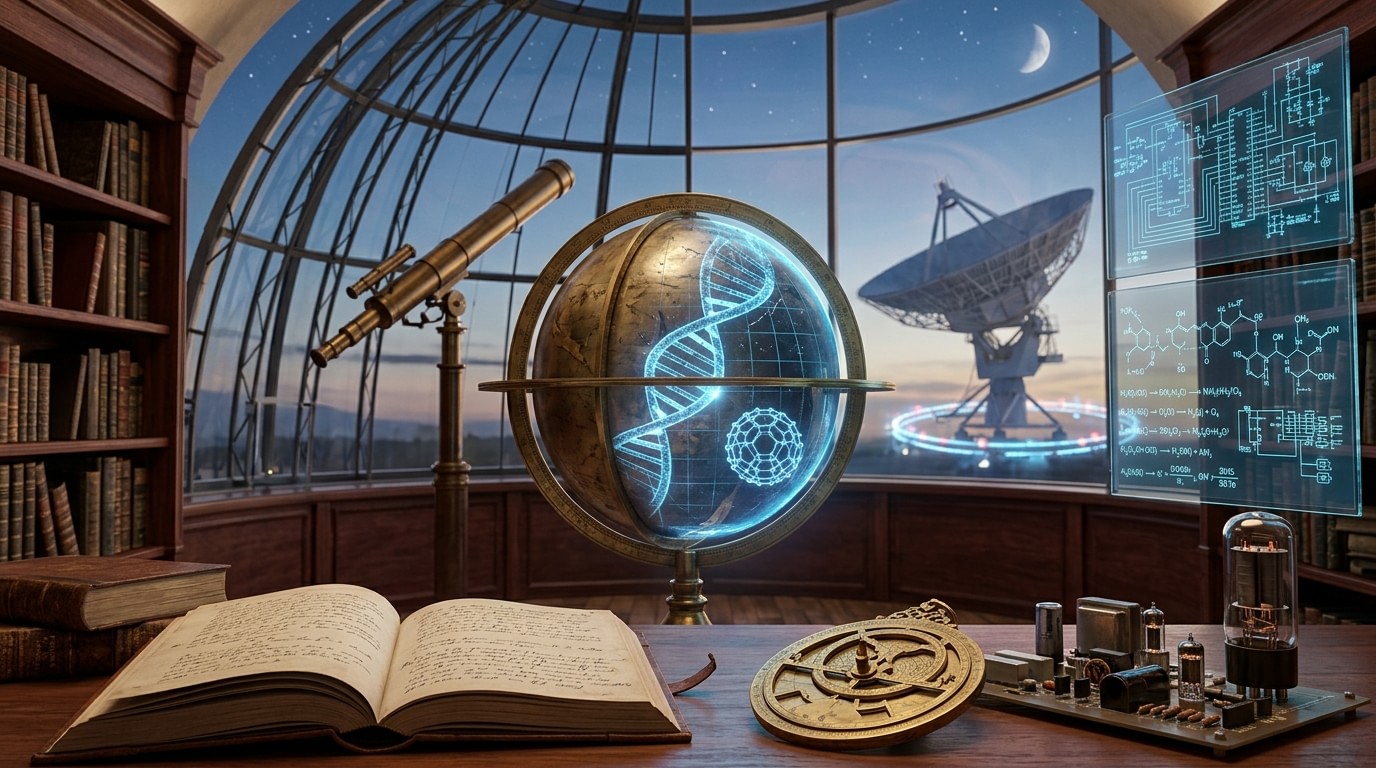
This November features fundamental leaps in physics, computing, mechanical engineering, space exploration, astronomy, and medicine — from the first X-ray to the first microprocessor, from lunar rovers to the birth of television and the discovery of nitrogen.
This November features fundamental leaps in physics, computing, mechanical engineering, space exploration, astronomy, and medicine — from the first X-ray to the first microprocessor, from lunar rovers to the birth of television and the discovery of nitrogen.
Notable Births & Deaths
November 1
- Birth (1886): Grace Medes, American biochemist. Known for research on the metabolism of fatty acids and sulfur-containing amino acids.
November 2
- Death (1944): Thomas Midgley Jr., American engineer and chemist. Discovered the effectiveness of tetraethyl lead as an anti-knock agent in gasoline.
November 3
- Birth (1749): Daniel Rutherford, Scottish chemist. Discovered nitrogen by isolating the portion of air that does not support combustion.
- Birth (1867): Martin Wilhelm Kutta, German mathematician. Co-developed the Runge–Kutta methods for numerical solutions of differential equations.
November 4
- Birth (1929): Shakuntala Devi, Indian mathematician and mental calculator. Known as the "Human Computer," she demonstrated extraordinary calculation abilities and authored works on mathematics and puzzles.
November 5
- Birth (1854): Paul Sabatier, French chemist. Shared the 1912 Nobel Prize in Chemistry for metal-catalysed hydrogenation studies, critical to the fats and oils industry.
November 6
- Birth (1638): James Gregory, Scottish mathematician and astronomer. Designed the reflecting telescope and contributed to the development of calculus.
- Birth (1771): Alois Senefelder, German inventor. Invented lithography, revolutionizing printing technology.
November 7
- Birth (1867): Marie Curie, Polish-French physicist and chemist. The first woman to win a Nobel Prize and the only person to win Nobel Prizes in two different sciences (Physics 1903, Chemistry 1911). Discovered polonium and radium.
- Birth (1878): Lise Meitner, Austrian-Swedish physicist. Co-discovered nuclear fission and the element protactinium; element 109 (meitnerium) is named after her.
- Birth (1888): C. V. Raman, Indian physicist. Discovered the Raman Effect in light scattering, earning the 1930 Nobel Prize in Physics — the first Asian to receive a Nobel Prize in science.
November 8
- Birth (1854): Johannes Rydberg, Swedish physicist. Known for the Rydberg formula relating the wave numbers of spectral lines of elements.
- Birth (1917): Kamal Ranadive, Indian cell biologist. Established India's first tissue culture research laboratory and pioneered research on cancer and viruses.
- Birth (1923): Jack Kilby, American electrical engineer. Co-invented the integrated circuit and won the 2000 Nobel Prize in Physics.
November 9
- Birth (1914): Hedy Lamarr, Austrian-American inventor and actress. Co-invented a frequency-hopping spread spectrum system, laying early technical foundations for modern wireless communications.
- Birth (1934): Carl Sagan, American astronomer and planetary scientist. Known for pioneering research on planetary atmospheres and science communication.
- Birth (1935): Igor Novikov, Russian theoretical astrophysicist. Formulated the Novikov self-consistency principle addressing paradoxes in time travel.
November 10
- Birth (1919): Mikhail Kalashnikov, Soviet small-arms designer and mechanical engineer. Designed the AK-47, renowned worldwide for mechanical reliability and manufacturing tolerances.
- Birth (1888): Andrey Tupolev, Soviet aerospace engineer. Chief architect behind the Tupolev aircraft series, pioneering civil and supersonic aviation.
- Birth (1764): Andrés Manuel del Río, Spanish-Mexican naturalist and chemist. Discovered vanadium, initially naming it erythronium.
November 11
- Birth (1912): Huang Yaozeng, Chinese organic chemist. Pioneer of organofluorine and organometallic chemistry in China.
- Birth (1926): Marian Cleeves Diamond, American neuroscientist. Pioneer in neuroplasticity research, proving the structural adaptability of the brain.
- Death (1973): Artturi Ilmari Virtanen, Finnish chemist and Nobel laureate (1945). Recognized for breakthroughs in agricultural chemistry.
November 12
- Birth (1746): Jacques Alexandre César Charles, French physicist. Formulated Charles's Law on gas expansion and piloted the first manned hydrogen balloon.
- Birth (1842): John William Strutt, Lord Rayleigh, British physicist. Co-discovered argon, explained Rayleigh scattering, and won the 1904 Nobel Prize in Physics.
November 13
- Birth (1715): Dorothea Christiane Erxleben, German physician. First woman to earn a medical doctorate in Germany.
- Birth (1907): Herman Branson, African-American physicist and chemist. Made foundational contributions to discovering the alpha helix structure of proteins.
November 14
- Birth (1863): Leo Hendrik Baekeland, Belgian-American chemist. Invented Bakelite, the world's first fully synthetic thermosetting plastic.
- Birth (1891): Sir Frederick Banting, Canadian medical scientist. Co-discovered insulin (1921), transforming diabetes treatment globally.
November 15
- Birth (1738): William Herschel, German-British astronomer. Discovered Uranus (1781) and infrared radiation (1800).
- Death (1919): Alfred Werner, French-born Swiss chemist. Won the 1913 Nobel Prize in Chemistry for founding research into the structure of coordination compounds.
November 16
- Birth (1717): Jean le Rond d'Alembert, French mathematician and physicist. Co-editor of the Encyclopédie and contributor to fluid mechanics and the theory of music.
- Birth (1896): Pavel Sergeevich Alexandrov, Russian mathematician. Founder of the Soviet school of topology.
- Birth (1934): Mieczysław Mąkosza, Polish chemist. Known for discovering aromatic vicarious nucleophilic substitution and phase transfer catalysis reactions.
November 17
- Birth (1790): August Ferdinand Möbius, German mathematician and astronomer. Known for the Möbius strip and Möbius function.
- Birth (1902): Eugene Paul Wigner, Hungarian-American physicist. Won the 1963 Nobel Prize in Physics for contributions to the theory of the atomic nucleus and elementary particles.
November 18
- Birth (1787): Louis Daguerre, French physicist and artist. Inventor of the daguerreotype photographic process.
- Birth (1863): Odón de Buen, Spanish naturalist and oceanographer. Founded the Spanish Institute of Oceanography in 1914.
- Birth (1897): Patrick Blackett, British physicist. Won the 1948 Nobel Prize in Physics for discoveries in cosmic rays and nuclear physics.
November 19
- Birth (1711): Mikhail Lomonosov, Russian polymath. Made foundational contributions to chemistry, physics, and astronomy; anticipated the law of conservation of mass and co-founded Moscow University.
- Birth (1880): James Sumner, American chemist. Shared the 1946 Nobel Prize in Chemistry for discovering that enzymes can be crystallized.
- Birth (1894): Heinz Hopf, German mathematician. Known for the Hopf fibration and contributions to topology.
November 20
- Birth (1889): Edwin Hubble, American astronomer. Proved that the Andromeda "nebula" was a galaxy outside the Milky Way and established the expanding universe.
- Birth (1952): Shigeru Miyamoto, Japanese video game designer. Creator of Super Mario and The Legend of Zelda, shaping interactive entertainment technology.
- Death (1922): Francis Aston, British chemist. Won the 1922 Nobel Prize in Chemistry for developing the mass spectrograph.
November 21
- Birth (1871): Clotilde-Camille Deflandre, French physician. Co-discovered erythropoietin, the primary natural stimulator of red blood cell production.
- Birth (1901): Hieronymus Richter, German chemist. Co-discoverer of indium, used in transparent electrodes for LCDs and touch screens.
November 22
- Birth (1942): Guion Bluford, American aerospace engineer and astronaut. The first African-American in space.
- Death (1944): Arthur Eddington, British astronomer and physicist. Led the 1919 eclipse expedition confirming general relativity and pioneered stellar astrophysics.
- Death (1907): Asaph Hall, American astronomer. Discovered and named the two moons of Mars, Phobos and Deimos.
November 23
- Birth (1616): John Wallis, English mathematician. Pioneered infinitesimal calculus and introduced the symbol ∞ for infinity.
- Birth (1927): Erik Rotheim, Norwegian chemical engineer. Patented the first valved aerosol can, precursor to the modern spray can.
November 24
- Birth (1911): Xing Qiyi, Chinese organic chemist. Made key contributions to the total synthesis of bovine insulin, a landmark achievement in Chinese science.
- Birth (1914): Bessie Blount Griffin, African-American physical therapist and inventor. Invented a feeding system for amputees and taught adaptive methods to disabled veterans.
November 25
- Birth (1925): Paul Henry Latimer, American biological physicist. Discovered selective scattering in photosynthetic systems.
- Death (1884): Adolph Kolbe, German chemist. Developed Kolbe electrolysis and the Kolbe synthesis for salicylic acid, the main component of aspirin.
November 26
- Birth (1894): Norbert Wiener, American mathematician. Founder of cybernetics and pioneer of stochastic and noise processes.
- Birth (1817): Charles-Adolphe Wurtz, French chemist. Discovered the Wurtz reaction for synthesizing hydrocarbons and glycol.
November 27
- Birth (1857): Charles Scott Sherrington, British neurophysiologist. Coined the term "synapse" and shared the 1932 Nobel Prize for discoveries on neuron function.
November 29
- Birth (1803): Christian Doppler, Austrian physicist. Described the Doppler effect, fundamental to astronomy and radar.
November 30
- Birth (1761): Smithson Tennant, British chemist. Discovered iridium and osmium, and proved that diamonds are pure carbon.
Milestones & Discoveries
November 1
- First Hydrogen Bomb Test (1952): The United States detonated "Ivy Mike," the world's first thermonuclear device, at Eniwetok Atoll in the Marshall Islands.
- Universal Adoption of GMT (1884): Greenwich Mean Time was adopted as the universal time standard at the International Meridian Conference.
November 2
- First High-Definition Television Service (1936): The BBC launched the world's first regular high-definition public television service from Alexandra Palace, London.
November 3
- Sputnik 2 and Laika (1957): The Soviet Union launched Sputnik 2, carrying Laika — the first animal to orbit Earth. The mission demonstrated the feasibility of life support in orbital spaceflight.
- Mariner 10 Launch (1973): NASA launched Mariner 10, the first spacecraft to use a gravity assist and the first to visit two planets (Venus and Mercury).
November 4
- Tutankhamun's Tomb Discovered (1922): British archaeologist Howard Carter found the steps leading to the tomb of Pharaoh Tutankhamun in Egypt's Valley of the Kings.
- First Issue of Nature (1869): The inaugural issue of Nature was published, beginning the world's longest-running scientific journal.
November 6
- First Electric Shaver Patent (1923): Jacob Schick obtained a patent for the world's first electric shaver.
November 7
- Marie Curie's Second Nobel Prize (1911): The Swedish Royal Academy announced Curie's Nobel Prize in Chemistry for her discovery of radium and polonium — making her the first person to win Nobels in two sciences.
- Raman Effect Discovery (1928): C. V. Raman discovered the inelastic scattering of light in Calcutta, a breakthrough that earned him the 1930 Nobel Prize and established India's modern physics legacy.
November 8
- Discovery of X-Rays (1895): Wilhelm Röntgen discovered X-rays, revolutionizing medical diagnostics and earning the first Nobel Prize in Physics.
- Gramophone Patented (1887): Emile Berliner patented the gramophone, using lateral-cut disc recording that became the standard for sound reproduction.
- Element 110 Detected (1994): Darmstadtium (Ds) was first detected at GSI Darmstadt, Germany.
November 9
- Saturn V Inaugural Launch (1967): NASA launched Apollo 4, the successful uncrewed flight test of the Saturn V rocket.
- Venera 13 Launch (1981): The Soviet Union launched Venera 13, which landed on Venus in 1982 to capture the first color panoramas of the Venusian surface.
- Discovery of the J/ψ Particle (1974): Simultaneous announcements by BNL and SLAC confirmed the charm quark, triggering the "November Revolution" in particle physics.
November 10
- Lunokhod 1 Launch (1970): The Soviet Union launched Luna 17 carrying Lunokhod 1, history's first successful remotely-driven robotic rover on the Moon. It landed on November 17.
November 11
- Cosmic Ray Identification (1925): Robert Millikan reported data confirming atmospheric high-energy radiation originates from deep space, coining the term "cosmic rays."
- Semiconductor Laser Breakthrough (1970): Zhores Alferov's team at the Ioffe Institute (Leningrad) achieved continuous room-temperature operation of double-heterostructure semiconductor lasers, enabling modern fiber optics.
November 12
- Voyager 1 Saturn Encounter (1980): The probe made its closest approach to Saturn, delivering detailed images of its ring structure and Titan's atmosphere.
- First Comet Landing (2014): ESA's Rosetta mission deployed the Philae lander onto comet 67P/Churyumov–Gerasimenko, achieving the first soft landing on a comet nucleus.
- CSIRAC Digital Computer Demo (1949): Australia's CSIRAC executed its first test program in Melbourne — making Oceania home to one of the earliest operational electronic digital computers.
November 13
- Mars 2 Launch (1971): The Soviet Union launched Mars 2; its lander became the first human-made object to reach the surface of Mars.
- Lunar Water Discovery (2009): NASA confirmed significant deposits of frozen water in permanently shadowed lunar craters via LCROSS impact data.
November 14
- Mariner 9 Orbits Mars (1971): NASA's Mariner 9 became the first spacecraft to orbit another planet, later mapping 85% of the Martian surface and revealing Olympus Mons.
- Color Television Patent (1940): Mexican engineer Guillermo González Camarena patented his trichromatic sequential-field color television system, later utilized by NASA.
- Fullerene C60 Discovery (1985): Researchers published the discovery of buckminsterfullerene, opening up carbon nanotechnology.
November 15
- Intel 4004 Release (1971): Intel announced the commercial availability of the 4004, the world's first single-chip commercial microprocessor.
- Buran Space Shuttle Flight (1988): The Soviet Union completed the maiden orbital flight of the Buran spaceplane, executing an entirely automated launch, orbit, and uncrewed runway landing.
November 16
- Arecibo Message (1974): Astronomers at the Arecibo Observatory broadcast the most powerful intentional radio message ever sent into space, aimed at the globular cluster M13.
- Americium Discovery (1944): The synthetic element americium (atomic number 95) was first discovered, now commonly used in household smoke detectors.
November 17
- Lunokhod 1 Lands on the Moon (1970): The Soviet Luna 17 mission successfully landed Lunokhod 1 on the Moon, the first remote-controlled robot to explore another celestial body. It operated for 322 days, far exceeding its planned lifespan.
November 18
- Daguerreotype Announced (1839): Louis Daguerre's photographic process was publicly announced, revolutionizing visual documentation and science.
November 19
- Lomonosov's Birth Anniversary (1711): Honoring the Russian polymath whose work anticipated the conservation of mass and helped found Moscow University.
November 20
- Hubble's Andromeda Discovery Published (1924): Edwin Hubble's findings that Andromeda was a galaxy outside the Milky Way were first published, expanding the known universe.
November 21
- Indium Co-Discovery Anniversary: Hieronymus Richter, co-discoverer of indium, was born. Indium is now essential for LCDs and touch screens.
November 22
- Eddington's Eclipse Expedition Legacy (1919): Honoring Arthur Eddington, who led the expedition confirming Einstein's prediction of light bending by gravity.
- Asaph Hall's Mars Moons: Hall discovered Phobos and Deimos in 1877, transforming planetary astronomy.
November 23
- Hubble's Andromeda Announcement (1924): The New York Times published Hubble's discovery that Andromeda was another galaxy, reshaping cosmology.
- Blue Origin New Shepard Landing (2015): Blue Origin's New Shepard became the first rocket to fly to space and return for a controlled vertical landing.
November 24
- On the Origin of Species Published (1859): Charles Darwin published his landmark work explaining evolution by natural selection.
- Apollo 12 Returns (1969): The second manned Moon mission returned safely to Earth.
November 25
- Kolbe's Aspirin Precursor: Adolph Kolbe's synthesis of salicylic acid laid the foundation for aspirin, one of medicine's most important drugs.
November 26
- Niobium Discovery Announced (1801): Charles Hatchett announced his discovery of columbium (niobium) before the Royal Society.
- Wurtz Reaction Legacy: Charles-Adolphe Wurtz, born this day, discovered the Wurtz reaction for synthesizing hydrocarbons.
November 27
- Sherrington's Synapse Legacy: Charles Scott Sherrington, born this day, coined the term "synapse" and won the 1932 Nobel Prize for neuron research.
November 29
- Doppler Effect Described (1842): Christian Doppler presented his principle on the frequency shift of waves from moving sources, now fundamental to astronomy and radar.
November 30
- Iridium and Osmium Discovery Legacy: Smithson Tennant, born this day, discovered both elements and proved diamonds are pure carbon.
"Music and Electronic Devices Designer. Drum and Bass Addict. Creative Mind as Lifestyle. Cat in past Life. Football, Ice Hockey and Snowboard Lover. Marxist."
Sono Il Re sul Carro Danzante.
Attraversando La Città Getto Via I Coriandoli Della Vostra Tristezza Regalando Passione Ed Estasi Nei Vostri Occhi.
Sono Il Re sul Carro Danzante.
Attraversando La Città Getto Via I Coriandoli Della Vostra Tristezza Regalando Passione Ed Estasi Nei Vostri Occhi.